Posted on

Waterproof watch

Montre de luxe pour homme conçue par un horloger français, montre étanche waterproof pensée pour la plongée. Découvrez comment ça marche et son étanchéité. conseil d'horloger

Understanding Water Resistance in Watches Without Drowning

Waterproof watch: Are you being lied to? Or is the international watchmaking industry miscommunicating?

The famous “20 m” engraved on your watch is not a sesame to set off in pursuit of the Kraken.

In practice, this “20 m” refers to a static pressure test carried out in a laboratory. In concrete terms, a 20 m watch will resist a pressure of 2 bars.

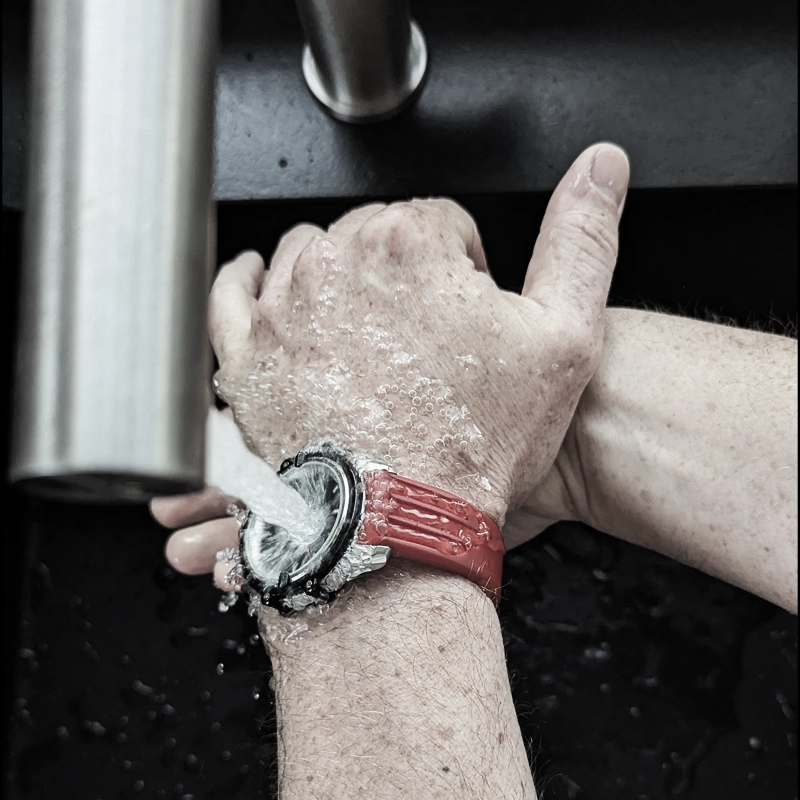
But under a jet of water (shower, tap) or in motion (swimming, diving), we’re talking about dynamic pressure. For the record, water pressure in a domestic installation is generally between 2 and 3 bars. So a jet of water directed at a sensitive area of your watch – such as the crown or case-back – could be fatal if it’s not equipped to withstand it.

For our diving friends, the confusion is even worse! When diving (in the real world, not in a laboratory), at a depth of 20 meters, water pressure is added to atmospheric pressure. So you feel a total pressure of 3 bars. In other words, the water resistance of a “20 m” watch won’t suffice at all.

Unfortunately, this information is all too often poorly communicated. The average customer reads “20 m” and thinks he can take a dip. But the brands cover themselves discreetly… in the instructions. Yes, that little leaflet folded like a Michelin map that you never read: it contains lines written in small print, specifying that the wristwatch is not actually designed for prolonged exposure to water, let alone in motion. The result: you take a shower with your beautiful brand-new automatic, it gets wet, and the after-sales service politely tells you that it’s “inappropriate use”. And there’s no recourse: it was written. In black and white. In the ten pages that nobody reads.

So why aren't all watches water-resistant to 1000 m?

The answer is simple: because it’s complicated.

Achieving true watertightness at 100 m (i.e. 10 bar pressure) requires real engineering work. Thicker gaskets are needed to withstand this pressure. This takes up a lot of space, without interfering with the internal mechanics. The watch also needs a thicker sapphire crystal, cut to resist crushing. And all this in a case that remains elegant, comfortable on the wrist, and not as thick as a chopped steak.

This explains why this is not a priority for all brands. Many prefer to aim for style, finesse or a controlled production cost, rather than take on the serious waterproofing headache.

As a result, we sacrifice a little safety for a simpler design. It’s a choice, but you have to understand it if you don’t want any nasty surprises.

A bit of technique:

When we talk about water-resistance, we think of a seal, a bit like a faucet gasket: it prevents water from passing through, and that’s that.

But in watchmaking, it’s a little more complex. Take O-rings, for example – those little rings of nitrile (a synthetic rubber) found on watch backs and crowns. Yes, even the crown can hide one, two, sometimes three gaskets… in just a few millimetres. And not all are created equal. Nitrile comes in several hardnesses, measured in shores, and the choice of hardness is crucial: it determines how the gasket will deform once compressed in its housing. Too hard, and it won’t crush enough. Too soft and it leaks.
It’s all a question of dosage, which I define at the design stage.

And that’s just the beginning. Ice seals are often made of Hytrel, a hard plastic capable of deforming just enough without breaking. But making a quality seal here is a different kettle of fish: we’re talking about a manufacturing tolerance of less than 50 microns.
Its shape, height, cross-section and compression calculation are a mixture of greasy formulas and years of experience. And don’t forget: high compression is all well and good, but the sapphire crystal mustn’t break during assembly. For these glasses, however hard they may be, remain fragile. And frankly, it’s not much fun picking up pieces of sapphire crystal.

Let’s talk about sapphire crystals. They’re scratchproof, but not unbreakable. A crystal 1 mm thick and 38 mm in diameter has no chance of holding up at 10 bars.
To withstand the pressure, the thickness of the glass must be adapted to its diameter and to the maximum pressure targeted. And that’s where the design drama begins. Because a watch that’s water-resistant to 200 m is all well and good. But it also means that the crystal will be 3 mm thick. So, aesthetically, it’s more complicated to make the watch slim and elegant.
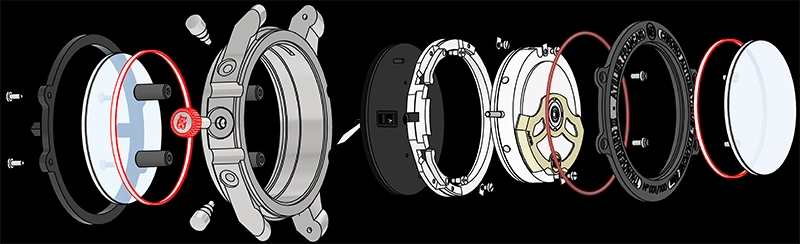
Montre étanche. Dessin de montre. Montre de plongée. Chrono titane ou en acier inoxydable à remontage automatic.

Tested, approved... and to be reviewed in 5 years.

Once the watch is assembled, it’s not over. Each part I make undergoes a water-resistance test at a higher pressure than the guaranteed one. Carried out using a special device, this test simulates the pressure build-up that would occur if the watch were submerged, without getting it wet. This is known as a dry air test, and enables us to detect the slightest deformation and therefore the slightest leak. We even go so far as to test your watch under negative pressure (as in an airplane depressurization test).

But water-resistance is not eternal, even with the best materials. Gaskets, however good they may be, age with time: they settle, crack and lose their elasticity. That’s why a check-up every 5 years is essential – and not just for intensive use.

And if in doubt, please don’t immerse your watch. It’s better to take it off for a bath, a shower or a paddle than to find it fogged up from the inside.

A final piece of workshop advice: some chemicals are devious enemies. Nail polish remover, perfumes, certain soaps, even insecticide sprays… all of these can attack seals without warning. So avoid putting perfume directly on your wrist.

Water-resistance is a delicate balance between precision engineering, quality materials and a little common sense.
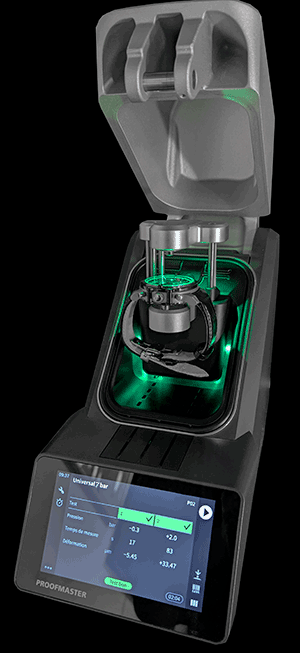
Montre homme, pour homme avec bracelet cuir ou bracelet alligator cousu main. C'est le contrôle d'étanchéité de montre mécanique, montre automatique par un horloger. Après le contrôle du cadran et des aiguilles dans notre manufacture de Morteau. Montre en titane ou acier.

A few recommendations:

To avoid water-resistance problems, adopt a few good reflexes: always make sure the crown is fully pushed in or screwed down before any contact with water. Never use the chronograph pushers when the watch is submerged.

Avoid contact with aggressive products – perfumes, solvents, insecticides, sprays – which can invisibly attack the seals. And finally, if in doubt, or if the watch has not been inspected for several years, it’s best to avoid immersion altogether.

When in doubt, contact us!

All my watches are tested to withstand 7 bars of pressure, the equivalent of 60 m diving. But to avoid confusion between meters, bars, immersion and water jets, I’ve decided to indicate the pressure directly in bars on future watches.

It’s clearer, more honest, and avoids many misunderstandings.

And if one day you have the slightest doubt about the water-resistance of your watch – because it hasn’t been looked after for a long time, or it’s suffered a shock, or simply because you’re keen on it – contact us to have it checked.
Posted on Leave a comment

I scratched my watch

I scratch my watch J'ai rayé mo a montre réparé une montre rayé, repair a scratched watch

"I scratched my watch"

Advice from a watchmaker

How many times have I heard the words ‘I’ve scratched my watch’?
Scratches and scuffs happen to everyone. In fact, these little marks are part of the life of your watch, telling its unique story. Whether you’re a keen collector or simply someone who appreciates the precision and beauty of a well-crafted watch, it’s inevitable that your watch will suffer a few scratches over time.

The Inevitability of Scratches: A Reality to Accept

Avoiding scratches on a watch is virtually impossible. Every time you move your wrist, every time you wear it, your watch is exposed to the elements and objects in your environment. Even if you are extremely careful, a scratch can occur at any time. The only good advice I can give you to avoid scratches is, quite simply: ‘remember that you are wearing your watch’.

I sincerely prefer someone who wears their watch, lives with it and risks scratching it, rather than someone who doesn’t wear it for fear of damaging it. As a watchmaker, I create these watches to see them live on your wrist.

polissage de montre watch polishing

Repolishing a watch

Repolishing a watch is an art in itself. It is possible to completely refinish your watch. But is it really what you want? Is it worth the cost?
And there are some parts that cannot be repolished.


Here’s how it works in our workshop:

Initial Assessment: We start by examining the watch to assess the extent of the scratches and damage. This allows us to determine which parts we will repolish and which we will change if you wish.

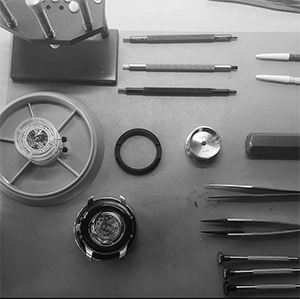
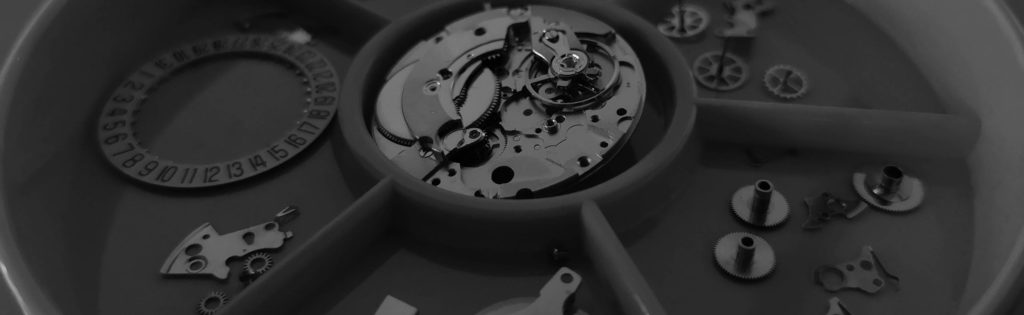
Dismantling: The watch is carefully dismantled to gain access to all the parts requiring polishing. The case and clasp are completely dismantled. The mechanical movement is carefully preserved and protected from the ambient air and dust.

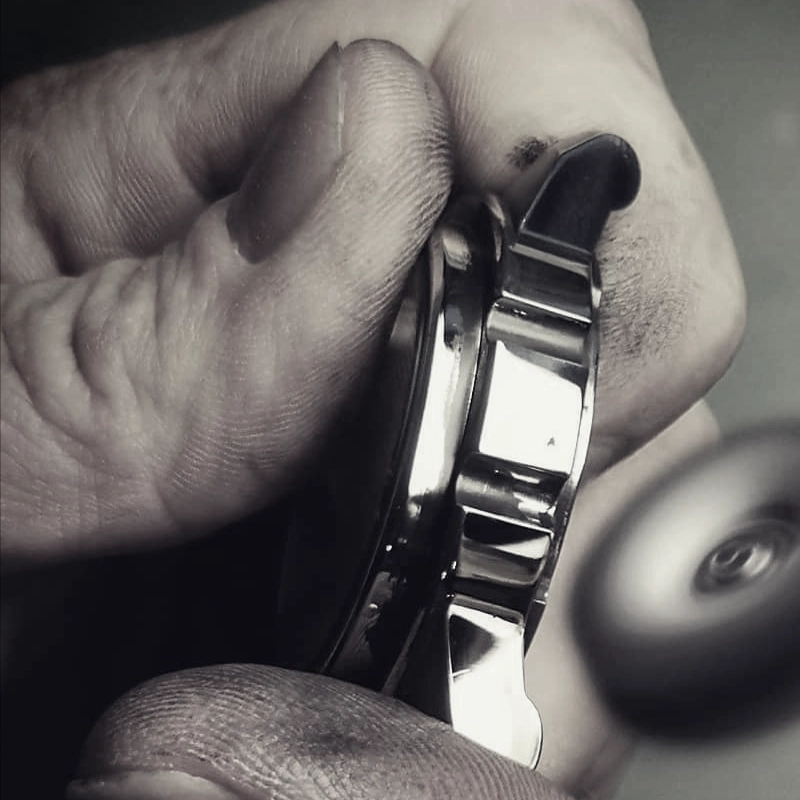
Polishing: Each component is polished by hand using different abrasives and specialised tools. This stage is crucial and must be carried out with extreme precision to avoid any excessive loss of material, which could alter the proportions of the watch.

Exceptions: There are some parts that we cannot repolish. For example, on our Thunderbird, Phénix and Alicanto models, the black bezels and backs have a surface treatment that we will remove if we polish them. In this case, if the part is badly damaged, it will be replaced by a new one. Sapphire crystals are also parts that we cannot touch up. Although scratch-resistant, they are not unbreakable, and an impact may chip the surface of the glass, in which case it will have to be replaced.
In all cases, we will be at your side to estimate the work that needs to be done on your watch.

Inspection: After polishing, each part is carefully inspected to ensure that any scratches have been removed without compromising the integrity of the watch.

Reassembly and Final Check: Once all the parts have been polished, the watch is reassembled and tested to ensure that it is working properly. We also carry out a final technical check (power adjustment, water-resistance test, 5-day checks) to guarantee a perfect result.

Watch care workshop Entretien d'une montre

Polishing your watch during a service

As you know, if you own one of our watches, I recommend that you return it every 5 years for a full service, which includes :

Cleaning the case and bracelet
A change of seals (crown and case back)
Checking the movement and adjusting it if necessary
Sharpening* your watch (case, crown, clasp, etc.)
A check of the running, water-resistance and winding after the watch has been reassembled.

*Polishing: Polishing is an operation designed to restore shine to surfaces. It is a light polishing. The term applies to polished, brushed, satin-finished or micro-beaded surfaces.

Conclusion

In short, scratching or breaking your watch is a common misfortune that should not alarm you. With the right care and regular maintenance, your watch can retain its beauty and functionality for many years. Don’t be afraid to say ‘I’ve scratched my watch’, my workshop is here to help you through this process, offering you high-quality services to ensure that your watch remains a precious jewel on your wrist.

In any case, don’t try to repair your watch yourself, as this would invalidate the warranty and, despite your watchmaking skills, could cause irreversible damage.

Please do not hesitate to contact us if you need any repairs, polishing or simply advice on how to look after your watch. Each watch has its own history, and we are here to help you preserve it.

Posted on

Automatic watch: Everything you need to know for maximum precision and style

Automatic watch Blog

How to tame your automatic watch

Have you just got your hands on an automatic watch and are wondering how to get the best out of it? Rest assured, the MB Watches team will give you the keys to taking care of it and enjoying every second that passes. So, are you ready to master your timepiece like a pro?

What is a mechanical automatic watch?

1. The magic of an automatic watch
Forget batteries! An automatic watch works with the movements of your wrist. If you wear it every day, it recharges effortlessly, thanks to a mechanism that is as fascinating as it is efficient. For the uninitiated, there are two types of mechanical watch: those that have to be wound manually and those that, like your automatic watch, are powered by every movement.

For example, the Alicanto, Phénix and Thunderbird are models with an automatic mechanical movement.

Montre MB Mikael BOURGEOIS Horlogerie

2. The autonomy of an automatic watch: your energy reserve
Your automatic watch has a ‘power reserve’: a sort of natural battery that enables it to continue running, even when not in use. Our watches at MB Watches last around 42 hours without movement. If it stops after a few days, don’t panic! Wind it by turning the crown (which is pressed against the case) clockwise up to about thirty turns, and that’s it.

A little personal tip: when my watch stops, I simply put it back on my wrist. I start my day without winding it or setting the time. After 15 minutes, it will have already stored up enough energy and will be back on its own. All I have to do is set the time and date again.

How to look after your automatic watch

Precision and tolerance of the movement
Your automatic watch may vary by a few seconds each day. Don’t worry, this is normal and is part of the charm of these mechanical watches. The precision of our settings is the big difference compared to other French watch brands. Most brands promise a fault of 20 or even 40 seconds a day. Our models leave the workshop with a fault of 5 seconds (or less) per day.

Has your watch suffered a serious shock? It’s possible that it’s a little out of tune. But that’s what we’re here for.

Precautions to keep your watch in perfect condition

1. Beware of shocks
Your automatic watch is robust but not invincible. Avoid wearing it for violent sports such as tennis or golf. But the best tests are those carried out in real life…

Anecdotes include violent falls from mountain bikes, watches ripped off and trampled on during metal concerts and firefighters going into fires with their watches. And yet their watches are still in perfect condition…

2. Water-resistance: be careful
Your watch is water-resistant, but watch out for products that attack plastics, solvents and certain perfumes. If you dive or swim frequently, you should have your watch checked for water-resistance every two years.

If it’s been several years since your watch has been checked in the workshop and you notice a slight fogging up inside, you should contact us immediately to change the seals.

3. Avoid magnetic sources
Keep your watch away from magnetic fields (telephones, speakers, etc.). Prolonged exposure could disrupt its mechanism, or even stop it altogether. If your watch suddenly jumps ahead for no reason, it is probably magnetised: take it to the workshop to be demagnetised.

4. Change the date, but not just any old time
Have you ever heard of the death zone? The time when you should not correct the date on your mechanical watch!

Among our models concerned, only the Thunderbird should not undergo a date correction between 10pm and 2am.
Our other models are not affected

More information on the death zone:
Here is our blog article
Here is our Youtube video

You are now equipped to enjoy your automatic watch to the full, without stress. The MB Watches team is here to help you keep your precision jewel in perfect condition. Because an automatic watch is a style, a legendary mechanism, and the ideal companion for those who live to the rhythm of their passions.

Club MB Watches
Posted on

I sold a watch to a king

The king's watch I sold a French watch to a king

The day I sold a watch to a king

I sold a watch to a king! And that day, I couldn’t believe it.
Since then, the Thunderbird II has had an aristocratic ‘je-ne-sais-quoi’ for me.
Let me tell you this incredible story.
If you don’t mind, let’s go back in time…

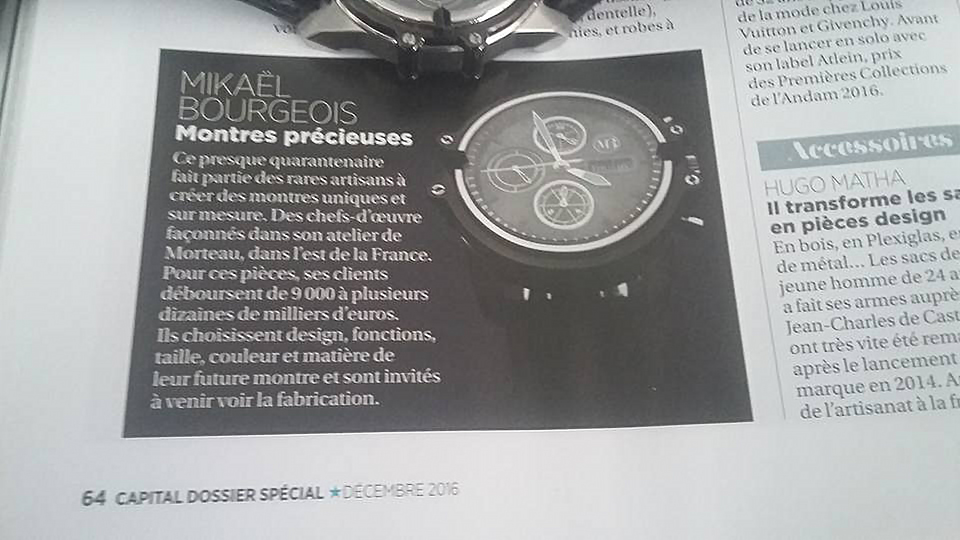
An appearance in Capital: Thunderbird II shines in luxury edition

An appearance in the magazine Capital: the Thunderbird II shines in the luxury editionIt’s December, and Christmas is fast approaching. And then, BAM, as if from heaven: a present! Not under the tree, no, but in the pages of the special luxury edition of Capital magazine. My watch appeared, shiny and apart, against a black background…

A happy coincidence: all the other watches had white backgrounds. Like a raw piece of Rock, my watch explodes in the middle of a smooth world. Can you see the picture?

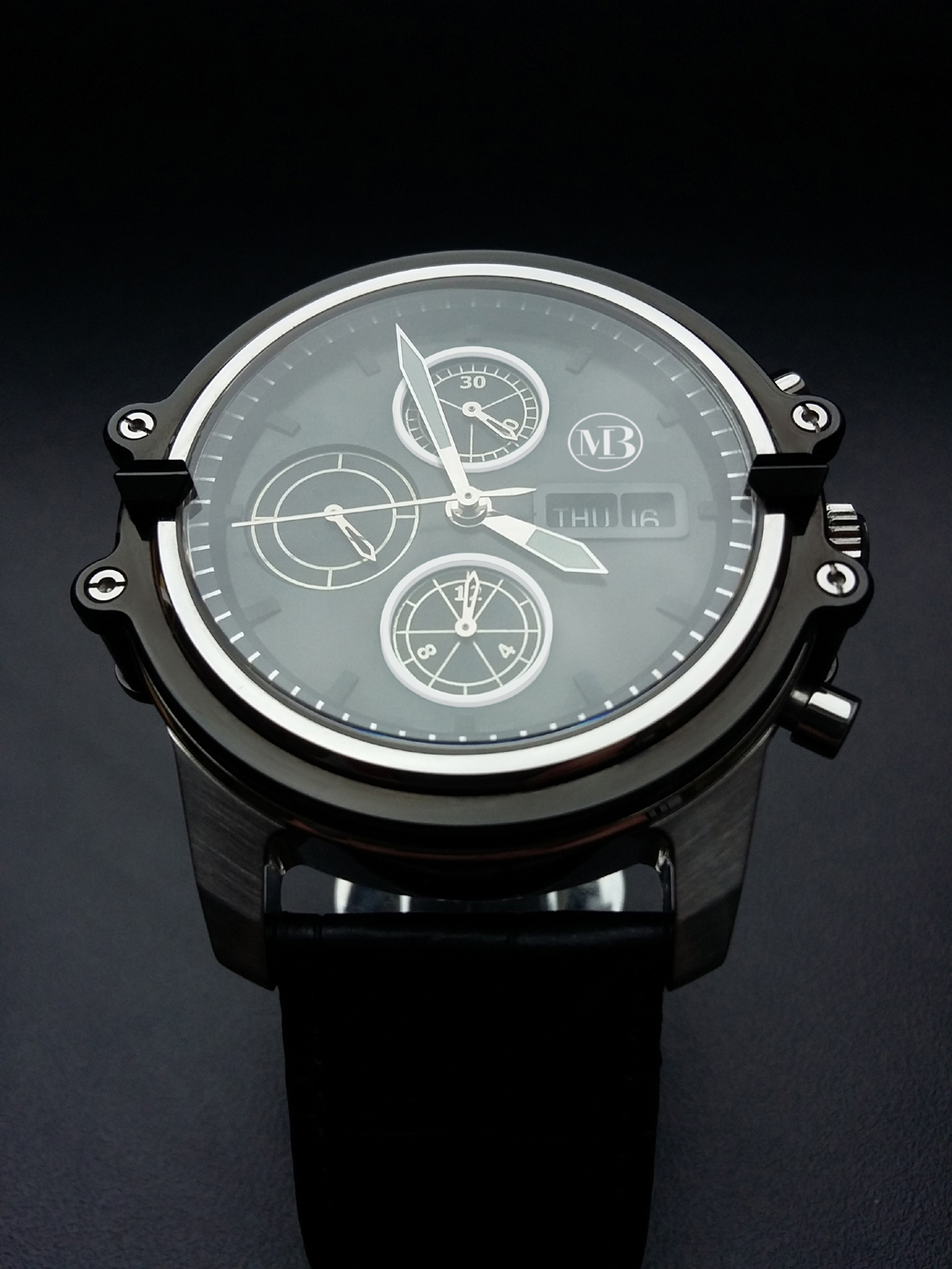
Luxury watch THUNDERBIRD

The King of Wakanda meets Thunderbird II

And that’s where the story takes on the trappings of a fairy tale or fantasy.

The King of Wakanda is in Paris and stumbles across the magazine. I’ve never really known how, but I imagine the magazine was waiting for him in his hotel.
As he flipped through the pages, he spotted the Thunderbird II and… it was love at first sight!

He fell in love with it and wanted it.

Just so you understand who he is, the King is said to be a great collector of luxury watches. And you know what they say… When a king wants something, he gets it!

And there was no shortage of them. Straight away, the Wakanda embassy contacted me. Just imagine the scene! At the time, I could hardly believe it. I thought: ‘Is this a joke? A scam?’ Not at all. Everything was perfectly clean. The deposit was soon paid and the order form was signed and stamped.

It was official!

Luxury Chronograph Made in our workshop

Royal delivery: a unique experience

I thought that would be the end of the story, that I would simply assemble the watch and send it off by courier. But no! Then it all happened: the embassy demanded hand delivery in Paris. That’s when I said to myself: ‘OK, royal delivery, let’s go!

So I prepare the Thunderbird II, model number 1. Because for a king, let’s face it, it’s 1 or nothing! And here I am in Paris, at the Wakanda embassy. Well, to be honest, the atmosphere isn’t exactly Rock. It’s cordial, polite, formal…

Oh, and sorry for those who were already imagining it: no meeting with the king, no royal handshake for me. No, I didn’t see the King put my watch on his wrist.
And with his private watchmaker, I’m in no danger of receiving a call for after-sales service. No promotional selfies either… And absolute discretion required! So you’ll understand why I can’t reveal his real identity.

An unforgettable experience and a dream come true

But I can tell you this: knowing that MY watch is in his collection… It’s enough to send shivers down my spine. I think that day I realised that anything is possible, that sometimes dreams do come true.

Mikael BOURGEOIS MB Watches

So who knows? Maybe now it’s your turn to dream and reign:
Ready to wear a watch fit for kings?

It’s coming, and it’s called Thunderbird III.